ABOUT THIS BLOG: OBJECTIVES AND GUIDELINES

What's my group?

Showing posts with label Group 9. Show all posts

Monday, May 30, 2016

Group 9

REMEMBER: every time you make a post, be sure to choose the label "Group 9" so that your post ends up in the proper place. If you don't do this, your post won't appear in your group and you won't get credit for it.
Also: if you put a link in your posting: highlight it to select it, then click on the "link" tool on the toolbar. (Click image below to enlarge).


For links in comments: enter the following HTML code into the comment box: 
<a href="www.google.com">Home</a> 
Change "www.google.com" to whatever website you want to link to. Change "Home" to whatever text you want to display as the link.

Tuesday, May 24, 2016

Weekly Post on Adam Smith and his 'Wealth of Nations'

I will present you two videos that can help you understand Adam Smith and Karl Marx better.


The video above summarizes some key points from Adam Smith's and Karl Marx's ideas. It clarifies the relations of cause & effect and gives examples concerning the philosophers' ideas. It covers Smith's Wealth of Nations, but does not touch upon the Estranged Labour or the Manifesto of the Communist Party. Instead, it gives insights about Marx's ideas about the class system and his views on Capitalism.

At the beginning, Adam Smith's concept of the "invisible hand" came somewhat complex and ambigious to me but the video HERE helped me better understand what it actually is and how it works and regulates the economy. You can find indormation regarding the simple relation between businesses, supply and demand relations, laizzez-faire and a brief glance at how economy changed over the course of time.

Weekly Post#4: A New Perspective for Macbeth's Personality


Above is the graphic of Macbeth and Lady Macbeth after killing Duncan the King, illustrated by R. T. Bone. In this image, Macbeth's wide open eyes indicate that he is horrified by what he has just done. He cannot stand on both legs balancedly, so he leans towards Lady Macbeth and holds her hand, which suggest that he has lost his control due to his shock, and is in need of help to carry on, not only psychologically but physically, too. Lady Macbeth, on the other hand, is still very confident, powerful enough to support and (still) manipulate Macbeth, as inferred from her upright posture, frowned looks and left arm and fingers that connote of giving orders or instructions for a new task.

The image made me able to criticize Macbeth's character, because I was more prone to blame external factors for evil deeds Macbeth committed, yet now I believe it is a personality flaw to be manipulated so easily and have a weak stance in terms of personal decisions and plans. Aristotle asserted that all tragic heroes have some sort of fatal flaw which causes the character's downfall; and in this case I argue if it was the real evil inside Macbeth or his weakness against Lady Macbeth and her manipulations that leads to Macbeth's downfall.

Weekly Post#5: All hail the play 'Macbeth'

"To mankind in general Macbeth and Lady Macbeth stand out as the supreme example of all that a host and hostess should not be." – Max Beerbohm

I am very surprised to find out some interesting sides of Shakespeare's play Macbeth - from the real names of Macbeth and Lady Macbeth to a "curse" caused by the 'unlucky'ness of the play. I would recommend you to take a look at this link!

I believe that all what we learn from this website are evidence for how powerful a play Macbeth is. 

To begin with, the idea of flattering a king's reign by a character in a play sounds ridiculous at first; but is the play is a one which flatters the concepts of fair and foul, dream and real, right and wrong, and which ends in a way that nothing in the world really has any meaning, yes, it can flatter a non-fictional king's reign as well.

Besides, the supposedly "curse" of Macbeth in theatres and the 1849 riot that took place in New York concerning the play both indicate how seriously the play was taken centuries after it was written.

The last point made on the page reminds us the contributions of the play to English language, although it is only indirectly related to what Shakespeare wrote... While we talk about all the hidden meanings behind the metaphors, symbols, long passages or the soliquys, we are so concerned about the meanings that probably very few of us pay enough attention on the language Shakespeare used. We appreciate all the ideas and emotions the play gives us, but we should appreciate the beautiful and neat language and style in which the play was written.

Smith & Marx's Definitions of Man

“Man is an animal that makes bargains: no other animal does this - no dog exchanges bones with another.”

The quotation above belongs to Adam Smith and it is not only his way of defining humans but also the distinction that separates humans from other animals, which reminds me of Karl Marx’s concept of ‘species being’.

Well, now it seems very tempting to compare Smith’s and Marx’s definitions and comparisons.

Bargain is the attempt to get something by paying less than its pre-decided price and it is a common thing in man’s world. Adam Smith believed that both the customer and the seller benefits from economic relationships as long as they get what they need. However, by nature humans are never satisfied with what they have, and have a never-ending desire to attain more; so, they try to get something while paying as little as possible. Marx, on the other hand, believes that man is a ‘species being’ who is universal in terms of needs and production; they produce more than necessary for later use, because satisfaction for the moment is not enough; instead, they organize their needs and production universally – considering any time and place.

In my opinion, while Marx’s definition is praise for humans, Smith’s definition is more prone to be understood as a criticism for humankind. For Marx, man is a higher being than non-human animals due to his superior way of living; however, Adam Smith’s quotation reminds me of the greedy, insatiable nature of humanity. Marx’s and Smith’s comparisons of humans to other animals support the conflict as well:

For Marx; humans are capable of working and enjoy working as a part of their lives for the chances of expressing themselves and meeting their needs; from this point arises their quality to build the future rather than the present moment only. This makes humans different from and pretty much superior to other animals. However, Smith highlights greed in his quotation because man is not seeking for an innovation or development but is merely showing his desire to have more in exchange of less. Besides, he does not compare man with an animal known for its hard work, serenity, etc. but uses dogs as the example of animal which is known for their aggression and violence for present needs. Considering these, I believe while Marx praises humanity in his definition of ‘species being’, Smith criticizes human nature. In my opinion, Smith has a more realistic explanation because even though Marx is right about human universality, humans maintain their greed and the desire for more even while practising this universality.

Monday, May 23, 2016

My Own Parable: What Do We Struggle For?

It was a rainy afternoon and on the street, with a fifteen-meter-distance between, were sitting two children with worn out clothes stained with mud and the raindrops. Their feet were naked and clothes too thin to protect them from the coldness the rain brought. They were calling the passers-by with their soft childish voices distinguished by reluctance and desperation. They resembled very much to each other, both had brown hair and brown eyes in the same shape and pale, thin lips which widened for a few seconds with every coin dropped before them; and with every coin each boy look at the other and smiled blithely.

A man, dressed in a radiant black suit, wearing polished black shoes and a navy tie, carrying a large black briefcase, dropped something out of his pocket to the hat where the boy’s coins accumulated; it did not fall down right away like a coin, it hovered in the air while the boy’s eyes widened and glowed with what he saw – it was a $100 banknote. When it fell on the coins, the boy took it up, his mouth opened in amazement and his eyes glimmered with joy. When he managed to take his eyes off from the banknote and look at his brother, he saw him watching with curious eyes. He folded the banknote quickly and put it in his pocket, tried to hide his astonishment, to act as usual and not to make an eye contact with his brother again. But his brother was collecting the coins before him and putting them in his pocket and was soon running towards him.

First he asked him what it was that he put into his pocket and the boy replied “Nothing.” His brother shouted and attacked onto him trying to take the money off from his pocket. Two little boys began to roll around the pavement, biting each other’s limbs and pulling each other’s hair whenever they could, shouting at each other sometimes in anger and sometimes in pain. The banknote passed from one boy’s hands to the other’s, and soon began to wrinkle, rip and fall apart. The coins in their pockets scattered around as they turned and rolled from one side to other. The many pieces of the banknote were scattering around and there were none left in the boys’ little hands. But they were still struggling, snarling and growling at each other, with blood on their teeth and limbs.

A passer-by man approached and stopped the two boys from hitting each other, and asked “What are you two fighting so hard for?” The two boys looked at the man and then each other blankly, and only after a while remembered the banknote and turned their heads to the ground where the coins and the pieces of the banknote were scattered around.

Sunday, May 22, 2016

Descartes Reflects on His Schooling

When I read Descartes' biography (see here), I came across his own words describing his schooling.


"I had been assured I could acquire a clear and certain knowledge of all that is useful in life. I had an extreme desire to learn them. But as soon as I had completed the course of study, at the end of which one is usually received into the rank of the learned, I entirely changed my opinion. For, I found myself embarrassed by so many doubts and errors, that I thought I had gained nothing else from trying to instruct myself, than to have more and more discovered my ignorance. I had learnt all that others learnt; - I had run through every book treating of such matters - that I could lay hands on - I did not see that I was deemed inferior - my own times appeared to me as fertile of good wits as any that had gone before. All of which made me think that there was in the world no such learning as I had been led to hope for. I took pleasure, above all, in mathematics, because of the certainty and the absoluteness of its reasons; but I had not yet found out its true use; and, thinking that it served only for the mechanical arts, was astonished that, its foundations being so firm and solid, nothing had ever been built on them that was more exalted. Concerning philosophy I will say nothing, except that, seeing it had been cultivated by the most powerful minds that had lived for many centuries, and that nevertheless there was not yet to be found in it one single thing which is not disputed, and therefore open to doubt, I had not the presumption to hope that I should succeed better than others; and considering how many different opinions there are, touching one and the same matter, all of which are maintained by learned persons, while it was impossible that more than one of them could be true, I regarded as little better than false everything that was merely probable. Then for the sciences, since they all borrow their principles from philosophy, I judged that nothing solid could have been built on foundations so far from secure."

A Quote for Hum112

Human nature is potentially aggressive and destructive and potentially orderly and constructive.
—    Margaret Mead


It may sound a bit too simple but if I was asked to summarize what I’ve learnt in this course in one sentence throughout the semester, I would say something very similar to what she said above. I think  duality is and will always be representative of our nature. 

2nd Essay Assignment: Beautiful Minds

                               A Comparison between Ideas of Descartes and Pascal:
                                                                Beautiful Minds

Rene Descartes and Blaise Pascal share similar starting point in their thought. Inspired by Montaigne, their skepticism and language are the important commonality which can be noticed easily. However, Descartes’ fight was against Scholastic philosophy whereas Pascal held strong arguments against the Jesuits. Descartes expressed his philosophy in a systematical way with a certain structure. On the other hand, nature of Pascal’s philosophy was never systematical or methodical.

In this essay, I will show Descartes’ and Pascal’s differences and points of contact. First off, I will focus on philosophers’ relation with skepticism to explore how skepticism differed in terms of its functions and motivations for each of the philosophers. Secondly, as they both put Reason at the core of their thought, I’ll go through thinkers’ engagement with reason to show what mainly separates them from each other. Thirdly, I will concentrate on thinkers’ attitude toward God’s existence and how and by what means they attempted to prove its existence. This aspect shows us how Doubt in these thinkers hints a major connection between them.

Descartes focused on skepticismbecause of epistemological reasons. He considered it as a useful tool to challenge beliefs since it permits doubt. He used doubt in order to destroy old philosophical structures and beliefs which are Aristotelian philosophy and Scholastic tradition. In Meditation One the Mediator thinks that all the things he knows come from his senses and they might lead him toward wrong conclusions. Therefore, he decides to undo his thinking and starts again from foundations to build his knowledge on more certain grounds. The Mediator also accepts that he might not be able to differentiate his present senses from dream images.  Thus, he concludes that he cannot doubt universal and simple things such as mathematics and geometry whereas composite things can always be doubted. Despite his skeptical attitude, doubt is not an end itself but a step for Descartes. On the other hand, Pascal is engaged with doubt in a very different way. To him, doubt is useful only when it helps man have the best possible orientation toward the religious experience. Because rational principals are vulnerable to the skeptical challenge, and therefore faith is the only real certainty. As it is seen clearly, there is a major difference the way thinkers relate with skepticism: Descartes uses skepticism as a ground for his thought and a way of endorsing reason, Pascal believes that skepticism proves the weakness of reason.

Regarding their attitudes toward reason, these thinkers place themselves at the opposite extremes. To Descartes, human’s existence does not require any place or material thing, because essence of a human being is simply to think. He methodically doubts everything and gives up his knowledge and beliefs. On the other hand, Pascal raises strong objections to Descartes’s speculative rationalism and cannot forgive that Descartes puts the reason at the very core of his thought with an isolation in hopes of reaching “its own self” and makes God irrelevant eventually. Pascal believed that it is not possible to answer every question through the use of reason, especially the ones which are outside the realm of reason. He suggested Descartes to enter from the heart to the mind, not from the mind into the heart. To him, totality created by God is essential to existence of humans, and one who follows reason exclusively cannot experience this fundamental totality.

            To Descartes, one can understand that God exists through her use of own reason. Since he proves existence of God by reasoning, his position on faith is ambiguous. In Meditation Three, he makes a deductive reasoning and proves that God is inherent. By Meditation Five the meditator’s empowered mind does not need any logical process because he finds the idea of God within himself just as surely as any shape or number. The idea of God can only come from a superior being since it belongs to nature of God. He states that his understanding belongs to nature of God is that God exists that is no less clear and distinct than is the case when he proves any number or shapes through mathematics and that God exists. Pascal believes that “it is the heart that senses God not reason”. And he defines faith as “the heart sensitive to God”.  This is where thinkers actually became separated on matters of reason and God as boundless. And, yet there are similarities between them. First thing which brings them together is axioms. To Pascal, axioms are anything perfectly self-evident and intuition helps us perceive them, which include “clear and distinct” perceptions of Descartes and mathematical axioms. Secondly, Pascal agrees with Descartes on the matter of Cogito: “I think, therefore I am”.

       In conclusion, each philosophers valued doubt in their own way. Descartes used doubt methodically to shatter old-order and initiate modern thought. Pascal protested against this by pointing out dangers of reason and put faith against doubt. Although they are just at opposite poles on very important matters, they, together, reflect the tension in modern man. 

Saturday, May 21, 2016

Hip-Hop & Shakespeare

A modern day hip-hop artist, Akala, in his Ted Talk, shows us the connection between Shakespeare and hip-hop and focuses on power of language on a broad level.

He starts with his speech by asking his audience if they can differentiate Shakespeare from hip-hop. 

And they can’t.

I think this creative artist raises the bar for everyone producing music today and contributes a lot to today’s music culture.


After watching his speech (see here) , it occurred to me that the link between modern hip-hop culture and Shakespeare is stronger than we think. 

Rising Working Hours for the Well-Off

Today, things seem a bit different than the old times.
  
(By old times, I mean the time of Marx.)

From Marx’s readings we know that the capitalist owns means of the production and makes their profit through the exploitation of the worker. To Marx, the actual job is done by the labor but surplus value directly goes to the capitalist. In this picture, the capitalist and the people of higher status appears to be lazy.

Marx would be surprised to find out that in today’s world Ceo’s, executives and rich people like to show that how busy and productive they are. Working for long hours signal social status in today’s world.  

Even movies show the well-off as ambitious proud workaholic.

Maybe, in today’s world does the discrepancy between the rich and the poor not only comes from the exploitation of the labor suggested by Marx, but also rising working hours for the well-off.

The research found that “the share of college-educated American men regularly working more than 50 hours a week rose from 24% in 1979 to 28% in 2006, but fell for high-school dropouts. Highly educated people take less leisure time than they did fifty years ago.”


The Economist’s article see here  focuses on this idea and offers an explanation with a link to the research. 

Friday, May 20, 2016

Marx: What is Capital?


In the societies with simple division of labor people transform commodities into money through circulation of commodities in the market. They sell commodities for money and then use that money to buy a commodity they need. However, capitalism requires different set of principles. Capitalists do not perceive money as a mean of the exchange process in which they only buy and sell things for money. They seek money for its own sake. The capitalist starts their business with a certain amount money, produces commodities which bring more money eventually to them. The money they use to run their business and obtain more money is called capital. Here, the main concern of capitalist is accumulation of more capital, not accumulation of more commodity. To Marx, capital accumulates through the creation of surplus value. Since the value of commodities come from the labor, this extra value only could be gained by exploitation of labors. As commodities of the capitalist is sold in the market at very competitive prices, he gains the advantage and become able to buy as much labor power from the worker at the lowest prices possible which is close to the cost of keeping the worker alive.

Here, his focus is heavily on the economic aspects of the issue. And he argues that the capitalist economic system creates the mechanism of exploitation and is source of social antagonisms that will eventually bring the end of the capitalism itself. 

Thursday, May 19, 2016

Third and Last Short Essay Assignment: History/ Memory


La Jetee & Kierkegaard

Human beings place great amount of emphasis on their memories when they need to make sense of their lives. Memories evoke varying emotions in us. Dealing with challenges of the present or uncertainty of the future, we recall them and create our unique relation with time. We can consider our past as a place in which our experiences, knowledge and values are created. In the short movie La Jetee, scientists hopes that they can recue the present by calling on the past and future. But finding a person who can bear such an experiment is not an easy thing for them. One should have mental strength to stand up to the shock of time travel. One of the prisoners become distinguished from others in terms of the clarity and strength of his memories. Here, the key to his past is a memory of a woman and a moment in which he saw a man dies. In this movie, we see that our connection to the past always has an important role in our lives in trying to understand the present and the future, but this connection cannot solve the puzzle of our lives. Although things in the past appear certain to us, they might have completely different meanings which we cannot understand them by looking at them from our current perspectives.

As it is stated in the movie, it is the story of a man marked by an image from his childhood without knowing the actual meaning of the image. The man sees his own death but he never realizes it until he returns and dies in his past. We can associate this with the idea of Kierkegaard, is that life must be understood backward but it must be lived forward. Because we cannot understand the progress perfectly when we look into the past. Here, looking to the future is not the solution either. There will always be events which seems not related to each other but require us to see the connection and link them together. Neither past nor future can solve this puzzle for us. To Kierkegaard, we should have the faith in that the dots will somehow connect in the future. This also shows us that we never can escape from the present even if time travel is possible. The present always drags us back into the here and now.

Also, in this movie we see that our civilization and technologic advancements does not only bring benefits to us but also cause distress in our lives. The time travel experiments in the movie take place in the aftermath of the Third World War. It actually reflects the atmosphere of 1960’s which is when the fear of nuclear annihilation was a major source of concern. Also, voices whispering in German gives us the historical context of the movie. This may be an allusion to the Nazi occupation of France which was still present in the French consciousness.


Tuesday, May 3, 2016

Blood Scenes in Roman Polanski’s Macbeth
Shakespeare’s play, Macbeth, is a tragedy based on a man, a tragic hero, who is the paradox of the fall from innocence to guilt, as he was driven by some both external characters and his internal desire in order to attain power. As the play is the representative of the Elizabethan tragedy, it involves blood scenes that is continuously used by Shakespeare. As in the play, blood is one of the recurrent symbols that makes the play a real tragedy and death scenes. Macbeth, as a play, was adapted to cinema by the director, Roman Polanski, who in many ways produced the film version of Macbeth being sometimes loyal to Shakespeare’s text. However the adaptation of the blood scenes by Roman Polanski is one of the effective representation and reconstruction of Shakespeare’s play through the addition of visual effects as portrayed in the blood scenes.
In fact, Roman Polanski used the blood scenes as producing visual effects and shot design for the aim of emphasis and stress of blood dominant in the movie. As given by Roman Polanski, blood symbolism and shot designs are used in two examples in the movie. One of the most important scene for depicting shot scene happens in the after morning when Macbeth kills the King Duncan. The cinematic effects also reveal this shot scene and blood is displayed through the red coloured sun rising lights on both Macbeth and the chambers of the King Duncan’s. The red shade and colour hence symbolizes the bloodshed in which Macbeth murders King Duncan cruelly, which is used to increase and raise suspension and emotion to the film for important effects.
Also the display and representation of the blood as the dominant and recurrent symbol of the film, based partly on the play, Polanski makes use of again the red colour in order to show the similar features and attributes. In this scene, Lady Macbeth and Macbeth lie in their bed and Macbeth thinks loudly by saying that For mine own good, All causes shall give way. I am in blood, Stepped in so far that, should I wade no more, Returning were as tedious as go o'er. Strange things I have in head, that will to hand, Which must be acted ere they may be scanned” (Act III, Scene 4). Thus, Polanski created a blood design in this scene, through stressing the significance of these lines by making them very effective. This effect is achieved through showing the audience the crimson tone for the display of the deaths which was caused by the tragic hero. 
HONORABLE DEEDS
            The old man was in his workplace when a poor girl knocked on his door. The girl was in rags and her feet were bare. "Why have you come to my door, child?", asked the old man, grunting and showing his unwelcoming attitude. The girl in rags replied with a rather shy voice; "If you can spare me some changes, sir, I would be very pleasant." She paused for moment, then looked down at her feet, which were already swollen. The old man's blacksmith was not making too much money and he was not very inclined to give his already scarce earning to the poor girl, who patiently and shyly waited in front of his gate. In order not to seem rude and greedy, the old man replied;"I am going to ask you a riddle, little friend, and if you can know the answer, I will give you a penny." The little girl was amazed because she had not been given any money for two days and the old man's promise was a hopeful event for her. She immediately replied with a yes. "Then, tell me, what is the thing which you carry all the time, even if you are dead.", the old man was being sly with this question because he knew there was no such thing which a man could carry, even in his death.The girl hesitated, then looked at the old man's prideful smile. She seemed to be struggling to find an answer. But suddenly, she spoke"One's honorable deeds, sir. Death strips everyone and everything away from one when it comes, but the honorable deeds stay with you, and by the help of them you could be remembered by those whom you had helped."

            The old man was shocked. The aside from the fact that the girl could find an answer, she also showed her wisdom and her faith in goodness. The tears came to the old man's eyes and after wiping them with an handkerchief, he invited the poor girl in, in order to offer her a hot soup and a few shillings which he saved for one week, as a token of gratitude towards the girl who had changed his life, forever, by reminding a harsh lesson on death and faith.

My Own Parable: Being a Tourist

She was preparing like a regular tourist for his trip to Amsterdam. She searched on the Internet what other people said about must-see-places. Based on the score that these touristic places have, she added them into her schedule carefully.  Anne Frank House, Van Gogh Museum, etc... But, who was Anne Frank? She hasn't thought about it since it wasn't necessary. No matter who they are, she should go and visit them because they were the most rated ones. Everything was planned, even she decided where to be at 9 or what to eat in where. After the vacation was over, her friends asked how was the trip and she said "That was good, I took a lot of photos."

Kafka Parables

Kafka wrote some parables, short stories, aiming to discuss daily lives of people and their inside world as well. These stories can be interpreted differently by differet people, and the reason of that is because everyone feels differently and experiences variety of different things. 
I will discuss about 'Before The Law' parable in this short essay, and will try to find out different interpretations of it. 

There is a guy in the story who is seeking to find wisdom and law, and believes that he can only do this by passing through the doorkeepers. As my own interpretation, I would say that doorkeeper is not letting him pass the door, because he needs to reach to a certain level of knowledge and have self-conscious. But the human being can be so ignorant sometimes that he cannot see he should develop himself. 

There is another interpretation I want to share with you too, you can find it in this link; An Interpretation. The writer points out an interesting opinion, imagine yourselves in a court and the doorkeeper as the judge. Even if you are innocent but if you cannot convince the judge about that he will still find you guilty. You have to defense yourselves with evidences or definite/accurate prooves. It wouldn't work if you only say that you are not guilty, you want to pass the door in this case. 

In the end, doorkeeper says that the door was only made for him, that it is special to him. I interpreted this as everyone is responsible from their own success and every one's success will open them different doors, tke them to different places of their lives. 

Sunday, May 1, 2016

Last short essay

A WELL KNOWN FICTION: HIS “STORY”
            Throughout the ages, human beings try to solve problems between nations. There is no any age or era without any destruction, war, mass death and all other bad things, adjectives and adverbs. There has been no any day without murdering, stealing and killing people for the sake of “goodness” of some people. Past and history are recordings of what happened in the previous days. There is a famous motto, which is “history is written by the victors.” For me, this is absolutely correct.
            Thomas Hobbes uttered those magical words: “Homo Homini Lupus”. A man is wolf to another man. That is, a man means a hunter to another one. This statement is a good detection. While reading it, it should be paid attention for how the words were chosen. There is no any word such as pigeon or other animals or things that symbolize peace or ease. Therefore, Hobbes made a good summarization of what human beings have done on this planet and history is the first hand witness which can be also considered as a “fiction.” If a work is fiction, then it can said that it is imaginary. Apart from this, understanding what is past and history is not so simple. In order to figure out the past and events occurred in history, all dynamics, things, characters, outcomes, consequences, reasons and other important things must be collected and evaluated together. History means the relationships between reasons and results of past events. Understanding the past has two dimensions. The first kind of past is our personal history while other is the collective conscious which is the history we all know.
            Apart from the fact that all things mentioned above, at the beginning of human civilization, small tribes came together and then first nations and states emerged. All these figures had their own ambitions and there were some driving and determinant factors that directed them. Religion, personal ambitions, national goals and regional objectives were important figures in shaping the history of man. There were numerous wars and conflicts, wrath and cruelty in the history, which was celebrated by thousands of people in history. When we look at today’s world, which is considered as the age of technology, human rights, tolerance, science and democracy, it can be seen that the nature of man has not experienced any change. Wars, conflicts, national and regional objectives, personal ambitious and wrath are continuing to exist. There is no any peace and tranquility in any part of the world. There are many countries who are hostiles to each other. Numerous nuclear bombs exist in numerous unknown parts of world. In the last century, about 100 million people died in conflicts and this century was called as “intellectual era”. It was an era of technology, intellectual, information, philosophy and art century. However, there had been no any era which included such kind of death toll and these were humans.

            When it comes to current situation of Western civilization for 21th century, there is nothing which has changed. We entered the new century with the occupation of Afghanistan and Iraq by the greatest military and economic power of the world, which is advertised as the country of freedom. For the sake of freedom and democracy, people were killed. People were freed from this life. New technologies have been introduced into our lives however, people is not able to reach a high humanism. Ideologies, national ambitions and other factors stated above are still valid for barbarism, murdering, mass destruction and exploitation. All of these are recorded into the books and all of these will become history. Generations of future will read about them and while we can’t understand the reasons and results of some incidents that occur in our own age, the future generations will also have difficulty in reading them correctly, too. As civilized men, we have not been able to take some lessons from the past. We have not been able to read from the past in order to prevent new destruction, however, we have failed. If I were able to travel in time, I would go into past and make people sign a common declaration for “not killing” people. Taking life of a man is the worst thing in this world. Past could be recorded again with that declaration. Children of Nagasaki and Hiroshima could be living now as grandmothers and grandfathers. However, no, there is nobody affected by those nuclear bombs living now. They are dead. History, past and all values that are supposed to make us “more civilized” are dead now. As stated in the death of Lady Macbeth’s death, this life, and world is a tale, told by an idiot, full of sound and fury, signifying nothing. 

Sunday, April 24, 2016

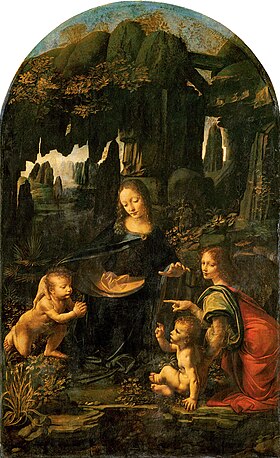
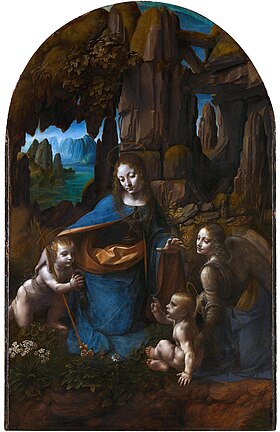
The Virgin of the Rocks (sometimes the Madonna of the Rocks) is the name used for two paintings by DA VİNCİ, of the same subject, and of a composition which is identical except for several significant details. The version generally considered the prime version, that is the earlier of the two, hangs in the LOUVRE in Paris and the other in the National Gallery, London. The paintings are both nearly 2 metres  high and paintings are painted in oils. Both were painted on wooden pane.Both paintings show the Madonna and Child Jesus.


Leonardo da Vinci - Virgin of the Rocks (Louvre).jpgLeonardo da Vinci Virgin of the Rocks (National Gallery London).jpg

Creation of Adam

Creation of Adam is created by Michelangelo.  This work can be divided by a diagonal line. First part is the left part which describe garden of eden. Adam’s powerless body  wait in order to energise at Garden of Eden. Second part describe moving of God and Angels. The middle of picture attract attention. This is because Adam’s and God’ s fingers seem as uniting.  This is the area where the sky and earth unit. Michelangelo’s style is strong in this picture because we feel that Adam will energise. Lastly, some people claim that Eve is here in the picture and is under God’S left arm. This is because she has more elegant lines depend on other angels and people think that she is Eve.